I woke up late again.
The night before had been a "great" time bingeing YouTube until way too late, and I stumbled out of bed and down the hall to my office. Per usual, it was downhill from there. I skipped walking the dogs. Skipped my journal. Launched myself into a day that already felt like it had left me behind.
The work got done, but everything was an emotional lift. Scrambling to get through this design to get to that email to get to the next meeting. I finished the day frayed and exhausted.
I was not great company at dinner.
Everyone went to bed. I just needed a little me time to unwind. Just a quick check on my YouTube subscriptions...
Anyone else know this drill?
You started your own business — or went freelance, or went remote — so you'd have more time. More freedom. More of yourself left over at the end of the day. But your days are as frantic as ever, and the people who were supposed to get more of you are getting whatever's left.
I tried all the things.
I've flip-flopped between analog and digital solutions multiple times over the last decade. Once, I bought a big piece of sheet metal and screwed it to the wall. With dry-erase markers I created a Kanban grid for project steps. I embedded rare earth magnets into 1x1 inch walnut and pine blocks to stick my 3x5 cards to their proper spots on the grid.
It lasted a few weeks.
The chore of writing the card, walking to the board, placing it in the right column — it always broke down when I got busy. And a voice in the back of my head was already critiquing it: "How do you expect to put four emails and a meeting's worth of info on a 3x5 paper card? You have to keep that digitally. Let's just go back to all digital — but with new software!"
Rinse and repeat that story every couple of months for ten years.
The true cost wasn't just time and ROI. My family was paying it too — as I rolled into supper barely able to see the broccoli on my plate, because I couldn't leave the work in the office at the end of the day. I could see the disappointment in my wife's face as I couldn't get off my phone. In my son's silence as I couldn't engage in his superhero comparison conversation.
I had started this business to be with them. But my mind was everywhere but in that kitchen.
My wife had been hinting at it for years. I hadn't been able to hear her.
The idea that I might have ADHD didn't compute. I wasn't some snotty-nosed kid bouncing off the walls. I didn't have trouble concentrating.
I had trouble stopping my concentration.
Wait.
"Do I have legitimate holes in my memory and function where I don't even realize what I don't realize? Is this why none of these productivity systems help me productively systematize anything?"
The diagnosis changed how I understood myself. But it didn't hand me a solution. What it handed me was a better question:
What would a structure built for this brain actually look like?
I spent a teenage summer working as a laborer for a bricklaying crew, so I know what scaffolding is.
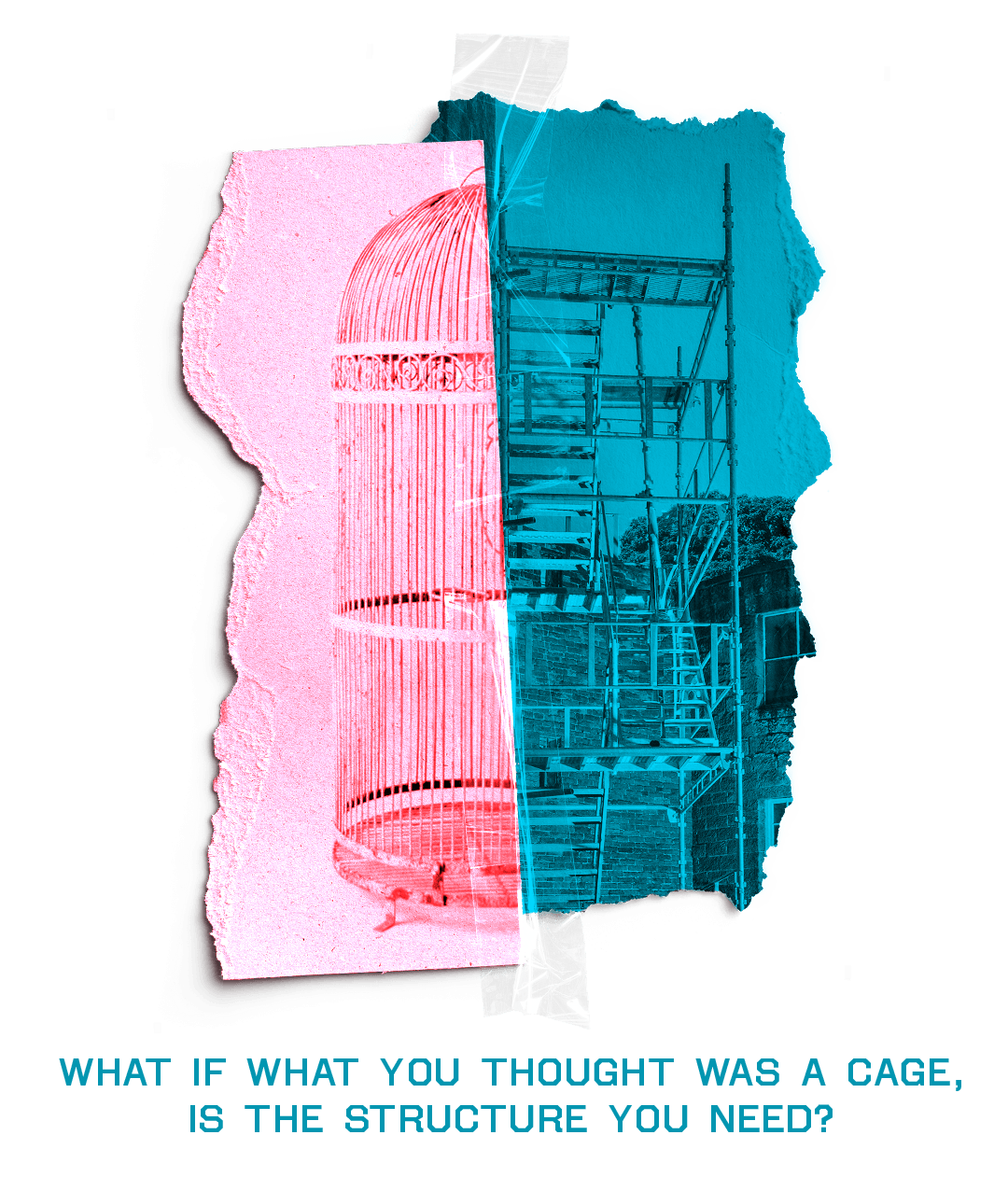
Scaffolding is temporary, adjustable, expandable. It supports the thing being built without becoming the thing itself. And when I put the word Elastic in front of it, something clicked. That tension — between structure and flex — is exactly the problem creatives with chaotic schedules and non-linear brains are actually trying to solve.
The Elastic Scaffold™ runs on four modes:
CENTER — Orient before the day makes its case for what's important. Five or ten minutes. Get there first.
EXPAND — Your future-focused work. The thing you're building, growing, or becoming. Protected time, before client work eats it.
OPERATE — Client work. The donuts. Someone always wants donuts. But this mode doesn't get to run your whole life.
RESTORE — Movement, meals, your people. Not a reward. Maintenance. Skipping this entirely is the only true failure condition.
You don't schedule tasks. You enter a mode — then do the highest-value work available inside it.
Last Monday I overslept.
We'd gone hard over the weekend and I rolled out of bed at 9:03am.
Here's what happened: I pulled on shorts, threw on my weight vest, took the dogs on the short-route walk. Home. Shower. Fifteen minutes with my journal. Thirty minutes on a future project for my business. Then client work until 4pm — at which point I went downstairs and worked out with my son for 45 minutes.
Finished a few client revisions right before dinner. Then I intentionally stopped. Closed the loop. Went to bed at 10.
Here's what that same Monday looked like two years ago:
Rolled out of bed frantic. Straight to the desk. Skip the dogs, skip the journal, skip everything that wasn't billable. Work all day. Miss the workout with my son because there's always more to do. End the day exhausted and weighted so heavily toward everyone else's work that I needed "me time" — which meant staying up too late scrolling, creating the exact same problem day for myself tomorrow.
Same late start. Completely different life.
That's what the scaffold does. It doesn't require a perfect day. It still works on an imperfect one.
When you purchase the Elastic Scaffold™, you get five documents designed to be read in order:
Quick Start Guide
Simple orientation so you can run your first day in the system immediately. No setup spirals allowed.
The Elastic Scaffold™ Manifesto
The philosophy, the four modes, and the story behind why this exists.
When the Day Breaks™
Built-in failure logic for late starts, missed blocks, and real life. Because the system has to hold when things go sideways, or it's useless.
Evening Shutdown Ritual
A simple way to close loops, protect tomorrow's energy, and actually stop working.
In the Wild
Real-world example days showing how the system holds up outside ideal conditions. Visual, illustrative, not instructional.
INSTANT ACCESS.
NO FLUFF. NO FILLER.
This isn't a system for people who want to optimize every minute.
It's for creatives who are tired of systems that blame them when they fail.
It's for the person who built a custom magnetic wall board out of walnut and sheet metal and still couldn't get it together — and needs to know that isn't a character flaw.
It's for the one who started this business to be present at dinner.
If any of this sounds like your Monday, $27 is reason enough to make Tuesday something better.
I built the Elastic Scaffold for me. But I know I'm not the only one out there who's had that Monday.
$27 one-time purchase
Instant download. All five documents delivered immediately to your inbox.
Questions? Reply directly: aaron@cambydesigns.com